Adjustable Bed Guide
A Local In-Person Checklist for Testing Motion-Adjustable Frames
A showroom visit is your chance to find out what product descriptions cannot: how an adjustable frame moves, sounds, feels, and fits into the practical realities of your home. Use this checklist to compare options by testing them—not by relying on a feature list alone.
Searching for adjustable bed frames near me often starts with a map and a set of product pages. But the details that matter most can be difficult to judge on a screen. A frame may promise independent head and foot movement, a quiet motor, or convenient controls; what matters is whether those features work comfortably for you, with the mattress you plan to use and the room where it will live.
An in-person visit should be more than a quick demonstration. Give yourself time to operate the frame, try several positions, listen while it moves, and ask how delivery and service work. If you are comparing multiple adjustable beds, use the same routine at each location and take notes while the differences are fresh. That simple discipline can turn an impression into a useful comparison.
This guide focuses on the essentials: movement, noise, remote controls, comfort, access, compatibility, delivery, and after-sale support. It is intended as a practical, product-neutral resource for shoppers, caregivers, and anyone evaluating a change to their sleep setup.
Before you visit: define what the bed needs to do
Start with your everyday routine rather than a list of premium features. Think about when you expect to adjust the bed and why. You might want a gentle incline for reading, a position that feels comfortable during quiet rest, or a way to make getting in and out easier. If a clinician has offered positioning advice, bring it along—but treat a showroom test as a comfort and usability check, not a medical assessment.
Write down who will use the bed, whether one or both sides need independent adjustment, what mattress you have or expect to buy, and any limits on room dimensions or building access. A concise list helps you focus when a salesperson demonstrates features quickly.
- Positioning priorities: Which head, foot, or combined positions do you actually expect to use?
- Users: Will one person operate the frame, or do two sleepers need separate controls?
- Current mattress: Record its size, construction, age, and manufacturer’s model if known.
- Room and access: Note door widths, stairs, elevator dimensions, hallway turns, and available floor space.
- Practical constraints: Consider outlets, pets, mobility aids, bedside furniture, and noise sensitivity.
If you are shopping locally in New York City, delivery access deserves particular attention. A frame that fits the bedroom may still be difficult to move through a narrow stairwell, a small elevator, or a tight apartment entry. Measure before you go, and ask the retailer what measurements the delivery team needs.
The showroom test: operate the frame yourself
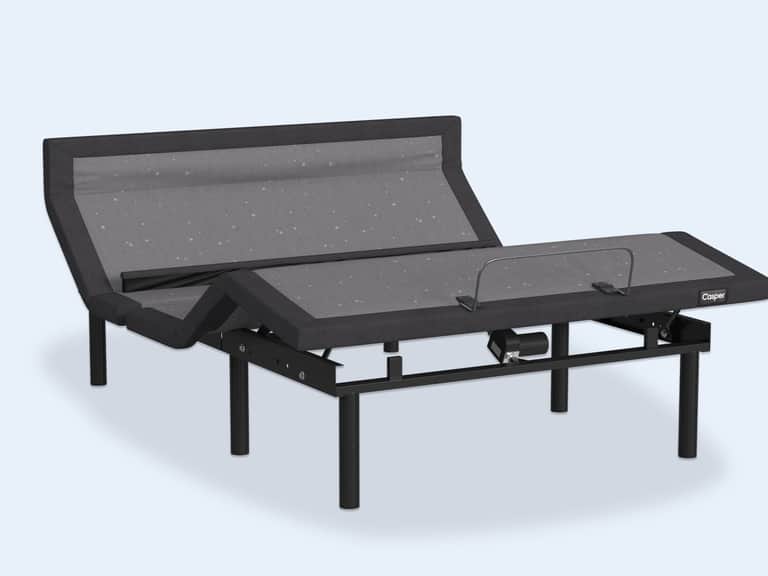
Ask to use the controls rather than watching someone else demonstrate them. Raise and lower the head section, then the foot section, and try a combined position. Move each section through more than one part of its range. A brief tilt may feel fine while a higher position reveals pressure, mattress bunching, or a control that is awkward to hold.
Return the frame to flat, then repeat the sequence. This helps you see whether the controls respond consistently and whether the transition is smooth in both directions. If the store allows it, try the bed with a mattress similar to the one you own. A bare base can demonstrate motion, but it cannot fully show how a mattress bends, how sheets shift, or how the complete sleep setup feels.
Notice the starting and stopping behavior. Does movement begin gently, or does it feel abrupt? Does the frame pause predictably when you release a button? Can you stop it at an intermediate angle without fuss? These are small observations, but they matter when adjustments become part of a nightly routine.
- Raise and lower the head independently.
- Raise and lower the foot independently.
- Try both sections moving together, if supported.
- Test at low, middle, and higher positions—not only at the extremes.
- Return to flat and check whether the frame settles evenly.
- Repeat the process to see whether the movement remains consistent.
Test positions you will actually use
A frame’s range of motion is only useful if its positions feel workable. Try an ordinary reading position, a relaxed resting position, and the position you expect to use for sleep. Settle into each for several minutes. Pay attention to your neck, lower back, hips, knees, and heels, as well as whether you feel secure and supported.
Consider the transition into and out of bed, too. If you use a cane, walker, or other mobility aid, ask whether you can test the approach and exit with your usual device. Check whether the bed height and frame edges feel manageable. A showroom cannot reproduce every home circumstance, but it can reveal questions worth resolving before purchase.
Do not assume that a position comfortable for one person will suit another. Sleep posture, body proportions, mattress feel, and personal preference all influence the experience. For a shared bed, each sleeper should test the setup. If the frame has a split configuration, confirm exactly what moves independently and whether there is a center gap or difference in mattress movement that you notice.
People exploring adjustable beds for a health-related reason should keep expectations measured. A position may feel more comfortable for some activities, but a showroom demonstration cannot establish that a bed treats a condition or replaces professional advice. Bring specific questions to a qualified healthcare professional when positioning is part of care planning.
Listen closely: motor noise and movement sounds
Ask for a quiet moment before testing. Showrooms can be busy, and background conversation may hide sounds you would notice in a quiet bedroom. Operate the frame while standing nearby, then listen from the pillow area. Note motor hum, clicks, rattles, or vibration through the floor. Some sound is normal for a powered mechanism; the important questions are whether the noise is acceptable to you and whether it changes across the frame’s range.
Test the frame more than once. A single movement may not reveal a sound that occurs only when the head or foot section is under load. If practical, lie on the mattress while another person operates the controls, then switch roles. This gives both users a chance to experience the sound and the motion from the position where they will spend the night.
Ask the retailer how to distinguish normal operating noise from a problem and what to do if sound develops later. Request clear information about troubleshooting and service rather than relying on broad assurances that a model is “quiet.” Your own listening test is still the most direct way to judge whether its sound level suits your household.
Check the controls for clarity and ease
A remote should make the frame easier to use, not require a lesson each time. Hold it as you would at home. Can you identify the head and foot controls without searching? Are the buttons distinguishable by touch? Does the remote have a clear layout, readable labels, and a backlight if you might use it in a dark room?
Try every control included in the demonstration, but separate essential functions from extras. Preset positions, massage settings, lighting, charging ports, and app connectivity may be useful to some people, yet they can add complexity. Ask which functions require a separate remote, a phone, or an internet connection. If the remote is wireless, find out how it is powered and what happens if its battery runs out.
- Can you operate the main movements without looking at the remote?
- Are labels and icons easy to understand?
- Can you stop movement quickly and predictably?
- Are preset positions adjustable or fixed?
- Is a backup control available if the remote is lost or damaged?
- What happens during a power interruption, and is manual lowering possible?
For a caregiver or household member who may help operate the bed, include that person in the test. A control scheme that feels obvious to one user may be confusing to another. The goal is not to master every feature in the store; it is to establish that the functions you need are straightforward and dependable.
Confirm mattress and frame compatibility
Compatibility is not a detail to postpone until delivery. Adjustable bases bend a mattress at designated sections, and not every mattress is designed for that kind of movement. Ask the frame retailer and the mattress manufacturer to confirm that the exact mattress model can be used with the exact base. Get the answer in writing when possible, especially if the mattress is still under warranty.
Discuss mattress thickness, weight limits, mattress retainers, and any restrictions on the frame’s use. Ask whether the manufacturer specifies a particular size or type of mattress, and whether an existing foundation, platform, or bed frame must be removed. A showroom pairing may not match your home setup, so verify the full combination rather than assuming that similar dimensions mean compatibility.
Also ask how bedding behaves during movement. Sheets may pull or shift as the sections rise. Check whether the frame uses a foot retainer or another method to keep the mattress in position, and ask how fitted sheets should be sized. For pillows, consider whether the loft and firmness still support your head and neck when the head section is elevated. A pillow that feels right on a flat mattress may need adjustment in an inclined position.
Look beyond the demonstration: fit, clearance, and setup
The showroom is not your bedroom. Ask for the base’s actual dimensions, including its height and any parts that extend beyond the mattress. Measure the planned location at home, leaving room for bedside tables, walking paths, and access to outlets. If the frame sits inside an existing bed frame, confirm the interior dimensions and support requirements rather than relying on the outside measurements.
Find out whether the base needs clearance underneath, whether its legs can be adjusted, and how cables should be routed. Check where the power supply and cords sit. They should not be pinched by a moving section, trapped against a wall, or stretched across a walkway. If you live in a compact apartment, consider how the bed will sit when flat and when raised, and whether it blocks a closet, door, or circulation route.
Ask what assembly involves. Does the delivery team bring the frame into the room, assemble it, connect the controls, and remove packaging? Is a second person needed for a particular step? Confirm whether the old bed or mattress can be removed, and whether that service carries an additional charge. The most helpful answer is a specific description of what is included—not simply “white-glove delivery.”
Ask direct questions about service, warranty, and returns
A motorized frame has electrical and mechanical parts, so service terms deserve as much attention as comfort. Ask who handles a repair, how to submit a claim, and whether service is provided at home or requires shipping a component. Clarify which parts are covered, for how long, and whether labor or transportation is included. Request the warranty document and read its exclusions before making a decision.
Ask what happens if the remote stops working, a motor fails, or the frame makes an unusual sound. How quickly are replacement parts typically arranged? Is there a temporary way to return the bed to a flat position? These questions are not predictions that something will go wrong; they help you understand the support available if it does.
Policies differ among retailers, manufacturers, and products. Confirm the return window, any fees, packaging requirements, and whether an opened or assembled base can be returned. Ask how mattress and base policies interact if they are purchased separately. Keep copies of the receipt, model information, warranty, and any written compatibility confirmation together.
A quick comparison sheet for adjustable bed frames
After each visit, record what you observed while it is still fresh. Keep the comparison focused on your priorities; a longer feature list does not automatically make one frame a better fit. Use a simple rating such as “good,” “uncertain,” or “not suitable,” and leave room for follow-up questions.
- Movement: Smoothness, range, transitions, and return to flat.
- Noise: Sound from the motor, remote, and frame under normal operation.
- Comfort: How your preferred positions feel after several minutes.
- Controls: Readability, button layout, ease of stopping, and backup options.
- Compatibility: Written confirmation for your mattress and frame combination.
- Fit: Dimensions, clearance, cord routing, and room access.
- Delivery: What is included, access requirements, timing, and removal options.
- Support: Warranty coverage, service process, repair logistics, and return terms.
- Total cost: Base, delivery, setup, accessories, and any optional services.
If two options seem close, revisit the comfort and control tests rather than letting a long list of secondary features decide for you. Ask the store to demonstrate the same functions on each model. Consistent testing makes an adjustable frame checklist more useful than an informal sequence of product pitches.
Common showroom mistakes to avoid
The first is testing only the most dramatic position. A high incline may be impressive, but your everyday comfort may depend on a moderate angle and an easy transition. The second is judging a base without checking the mattress. The mattress affects how movement feels, and its compatibility should be verified independently.
Another common mistake is assuming that more features mean more value. Massage, lighting, USB ports, presets, and app controls can be attractive, but the central questions remain: Does the bed move reliably? Can you operate it? Does the setup work in your home? Will you be able to get service if a component needs attention?
Finally, avoid treating a short test as proof of medical benefit. Comfort is personal, and health needs vary. A showroom visit can help you understand function and usability; it cannot diagnose a problem or guarantee a particular health outcome.
The final decision: choose evidence over showroom theater
Before you leave, make sure you have the exact model name, dimensions, price, delivery terms, warranty, and written compatibility information. Ask for a copy of the quotation and note any promised follow-up. If a question remains unanswered, pause before purchasing. A little extra time spent checking access, setup, or service can prevent a much larger inconvenience later.
The best in-person test is not the one that produces the most excitement. It is the one that gives you a clear picture of how a frame will behave in ordinary use: when you raise the head, settle into a comfortable position, return to flat, and use the controls in the quiet of your own home. Test the motion, listen carefully, and ask practical questions. Those observations are more valuable than brand claims alone.
For anyone comparing adjustable bed frames near me, the checklist is straightforward: try the movements, assess the sound, operate the controls, verify the mattress pairing, measure the route into the room, and understand the service terms. The result is not simply a more informed purchase. It is a sleep setup chosen with the realities of daily life in view.